Cut Commercial Facility TCO in 2027: A Strategic Budgeting Guide

October marks the peak of annual budgeting season for commercial real estate leaders and enterprise facility managers. As executive boards demand tighter fiscal discipline and operational efficiency, facility directors face an uphill battle: justifying maintenance spend to leadership who often view physical infrastructure solely as an expense line item.
Executing effective commercial facility budget planning requires moving past arbitrary baseline increases or across-the-board cuts. Leading enterprise property managers use a Total Cost of Ownership (TCO) model to balance operational expenditures (OpEx) with long-term capital allocation (CapEx).
This strategic framework provides actionable benchmarks, data-driven operational strategies, and financial frameworks to protect asset value, lower overall expenditures, and secure board approval for your 2027 facility operating budget.
Shifting from Reactive Spending to Total Cost of Ownership (TCO) Management
Total Cost of Ownership (TCO) in facility management is a comprehensive financial metric that accounts for all costs associated with acquiring, operating, maintaining, and replacing a commercial building asset throughout its useful lifecycle.
Transitioning from reactive repair budgeting to strategic TCO management shifts facility operations from an unpredictable cost center into a predictable driver of asset preservation.
The Hidden Costs of Deferred Maintenance on Commercial Asset Values
Total Cost of Ownership (TCO) Breakdown
| Operational Spend (OpEx) | Capital Spend (CapEx) |
| • Scheduled Preventive Service | • Major Equipment Replacements |
| • Day-to-Day Repairs & Supplies | • Structural Upgrades |
| • Utility Costs & Admin Overheads | • Asset Retrofits & Preservations |
Deferring routine maintenance creates compounding financial liabilities. Unperformed maintenance tasks degrade mechanical systems, shorten equipment lifespans, and increase energy consumption.
The financial impact of deferred maintenance follows an exponential growth curve. Industry research indicates that every $1 deferred in necessary preventive maintenance leads to $4 in future capital repairs or premature equipment replacement. Deferring maintenance degrades tenant satisfaction, lowers lease renewal rates, and suppresses net operating income (NOI), directly depressing overall commercial asset valuation.
Balancing Operational Expenditure (OpEx) vs. Capital Expenditure (CapEx)
Effective commercial building opex planning coordinates closely with long-term capital forecasting. Short-term OpEx reductions often trigger premature CapEx allocations when mechanical infrastructure fails early.
To balance OpEx and CapEx during budget creation:
- Categorize maintenance activities clearly: Separate routine service (OpEx) from structural improvements or system overhauls (CapEx).
- Track asset condition scores: Use Facility Condition Indices (FCI) to determine whether an aging asset requires ongoing operational upkeep or capital replacement.
- Model energy impact: Calculate how operational maintenance directly reduces monthly utility consumption, keeping energy costs stable.
Strategic Pillars of a Data-Driven Facility Operating Budget
Building a defensible 2027 operating budget requires structuring expenditures around core operational pillars. Focusing on these areas creates financial stability and operational clarity across single and multi-site portfolios.
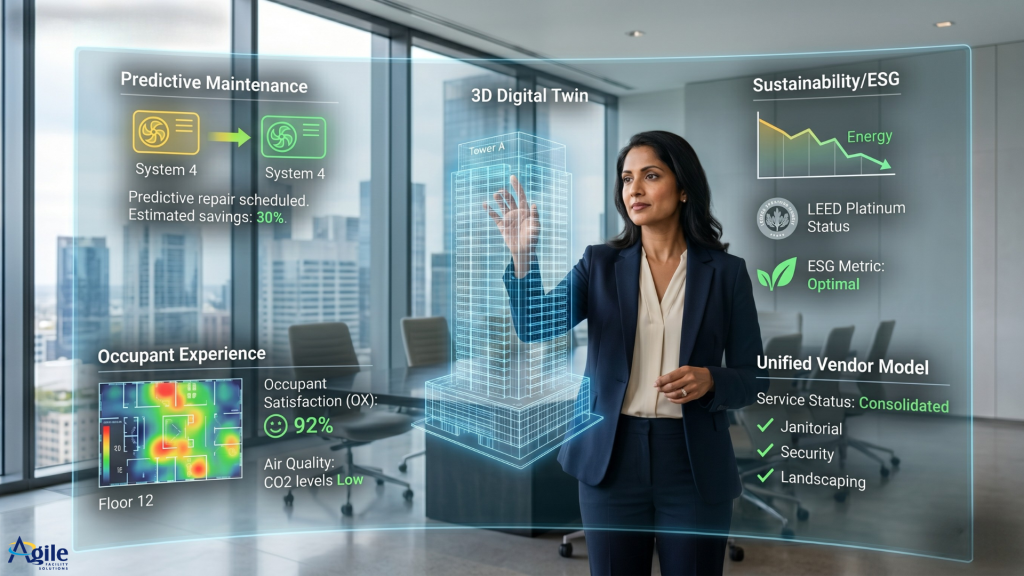
Predictive HVAC and Infrastructure Maintenance Allocation
HVAC systems account for up to 40% of total energy consumption in commercial properties. Allocating budget toward structured, predictive maintenance yields a immediate, measurable preventive maintenance ROI.
Scheduled filter replacements, coil cleanings, and sensor recalibrations prevent equipment failures during peak demand. Partnering with certified specialists for routine HVAC maintenance and repair prevents catastrophic compressor or chiller failures, keeping operational costs predictable.
Consumable Inventory Control and Automated Reordering Efficiency
Stocking commercial facility supplies often suffers from over-purchasing, stockouts, or decentralized purchasing across multiple site leads.
Integrating automated inventory management stabilizes consumable supply budgets. Setting automated reorder thresholds based on actual foot traffic and occupancy rates eliminates stock pileups, reduces inventory carrying costs, and frees up operating capital.
Single-Source Vendor Contracting to Eliminate Administrative Leakage
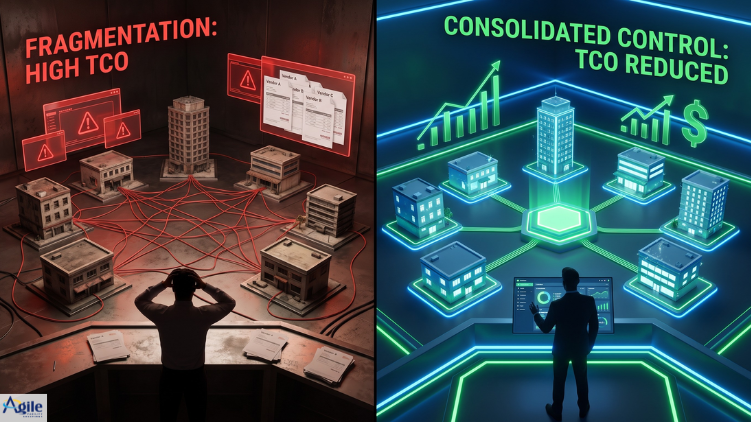
Managing multiple niche contractors for janitorial, groundskeeping, plumbing, and mechanical services creates administrative leakage: excessive overhead from processing hundreds of invoices, managing multiple service level agreements (SLAs), and paying overlapping service call fees.
Consolidating service providers through a multi-site strategic accounts program yields several financial advantages:
- Volume Pricing: Bulk rate discounts across all properties in a portfolio.
- Simplified Invoicing: A single consolidated monthly invoice that reduces accounts payable overhead.
- Consistent SLAs: Standardized service delivery across every location.
Evaluating High-Return Facility Investments for 2027
To gain board approval, highlight investments that yield rapid financial returns or extend capital asset lifespans.
| Strategic Facility Investment | Primary TCO Benefit |
| CleanCom® Real-Time Tracking | Eliminates SLA administrative dispute overhead and rework costs |
| Specialized Surface Preservation | Defers capital floor replacement costs by 5 to 10 years |
| Vendor Consolidation | Reduces procurement and accounts payable management fees |
Real-Time Maintenance Software SLAs (CleanCom® Technology)
Lack of vendor visibility creates billing disputes and unverified work completion. Implementing transparent technology like CleanCom® provides real-time proof of performance, work-order tracking, and SLA verification. Automated issue resolution reduces administrative oversight hours and ensures every budget dollar yields verified operational value.
Specialty Surface Preservation vs. Capital Replacement
Replacing high-traffic flooring, stone surfaces, or architectural elements requires major capital allocation. Incorporating professional restoration and protective coatings into your annual operating budget extends floor life cycles by 5 to 10 years, converting major capital expenses into predictable, manageable operating costs.
Building a Board-Ready Facility Budget Presentation
Executive boards and CFOs prioritize financial metrics, risk mitigation, and long-term asset value over basic maintenance task lists.
Follow this 4-step checklist to structure an executive budget presentation:
- Lead with Financial Metrics: Present costs on a cost-per-square-foot basis alongside projected NOI impacts.
- Demonstrate TCO Savings: Use historical data to show how increased preventive maintenance allocations directly reduce emergency repair expenses.
- Highlight Regulatory Compliance: Show how routine inspections prevent costly regulatory penalties and compliance liabilities.
- Provide Clear Options: Frame budget requests around baseline, optimized, and deferred scenarios, explicitly outlining the financial risks of deferred maintenance.