
Agile Facility Solutions

Author name: Darlene Bernd

ISO 5 to ISO 9 Cleanroom Cleaning Protocols: The Facility Manager’s Guide to Audit-Ready Compliance
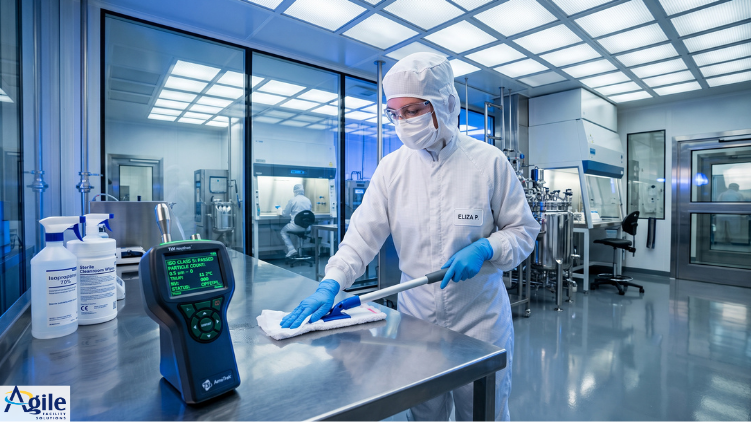
AdISO 5 to ISO 9 Cleanroom Cleaning Protocols: The Facility Manager’s Guide to Audit-Ready Compliance A single airborne particle or chemical residue can ruin a production batch, compromise research validity, or trigger an FDA warning letter. Maintaining controlled environments demands precise execution, certified chemistry, and continuous verification. Managing sanitation across varied ISO classifications requires balancing stringent micro-cleanliness in critical zones with operational efficiency in surrounding buffer areas. Developing standardized cleanroom cleaning protocols across ISO Class 5 through ISO Class 9 environments establishes verifiable, audit-ready compliance for cGMP facilities, biotech plants, and advanced data facilities. Understanding ISO 14644-1 Cleanroom Classifications and Micro-Contaminant Risks Cleanroom sanitation standards are governed by ISO 14644-1, which defines air cleanliness by airborne particle concentration. ISO Class 5 vs. ISO Class 9 Particle Threshold Standards Cleanroom requirements vary drastically based on classification thresholds: ISO Class Max Particles (≥0.5μm/m3) Standard Environment Type Primary Cleaning Focus Minimum Cleaning Frequency ISO Class 5 3,520 Aseptic Filling, Semiconductor Bay Ultra-low particulate removal, bioburden eradication Daily / Shift Change ISO Class 6 35,200 Pharmaceutical Preparation Micro-particle control, non-linting wipe-downs Daily ISO Class 7 352,000 Secondary Packaging, Medical Device Assembly Surface residue elimination, HEPA-assisted vacuuming Daily to Bi-Weekly ISO Class 8 3,520,000 Staging Areas, Gowning Rooms Gross contamination control, floor scrub protocols Weekly / Semi-Weekly ISO Class 9 35,200,000 Ambient Buffer Zones, Air Locks Particulate containment, entry barrier maintenance Weekly / As Needed ISO Class 5 environments permit no more than 3,520 particles () per cubic meter, demanding daily specialized decontamination. In contrast, ISO Class 9 represents an ambient baseline permitting up to 35,200,000 particles per cubic meter, serving primarily as a buffer zone to prevent particulate migration into cleaner spaces. Common Sources of Contamination in High-Tech & Life Science Facilities Human Shedding: According to the National Environmental Balancing Bureau (NEBB), personnel generate over 70% of cleanroom contamination through skin flakes, hair, and clothing fibers. Material Transfer: Raw materials and equipment moving into controlled zones introduce exterior dust, packaging debris, and cross-contaminants. Outgassing and Chemical Residues: Off-gassing solvents, aggressive non-neutral cleaners, and improper sealants alter room chemistry and leave microscopic residues on contact surfaces. HVAC Deficiencies: Turbulent airflow or degraded HEPA filtration allowed particulate settling on critical work surfaces. Standard Operating Procedures (SOPs) for Controlled Environment Sanitation Maintaining ISO controlled environment cleaning standards requires disciplined SOP execution that prevents cross-contamination across boundaries. [Personnel Entry & Gowning] ➔ [Top-Down HEPA Vacuuming] ➔ [Controlled Surface Wiping] ➔ [Chemical Disinfection] ➔ [Quantitative Verification] Proper Gowning, Personnel Entry, and Material Transfer Protocols Preventing cross-contamination starts at the threshold. Staff and third-party specialists must follow strict entry protocols before stepping into sensitive zones: Step-Off Pad and Sticky Mat Maintenance: Place adhesive mats at all transition zones. Peel top sheets daily or when visual saturation reaches 50%. Top-Down Gowning Sequence: Don protective wear from head to toe (hood, mask, coverall, booties, double gloves) to ensure shed particles fall onto ungarbed surfaces during the process. Material Pass-Through Sanitation: Spray and wipe all incoming equipment, containers, and tools with sterile 70/30 Isopropyl Alcohol (IPA) inside the airlock before introducing them to the cleanroom floor. HEPA Vacuuming, Particle Control, and Microfiber Surface Sanitation Physical cleaning must capture and remove contaminants rather than redistributing them. ULPA/HEPA Vacuuming: Use sealed, exhaust-filtered vacuums rated at 99.999% efficiency at  to pull particulates from walls, coving, and flooring joints. Continuous-Filament Microfiber: Deploy ultra-low particulate, laser-cut polyester or continuous-filament microfiber mops. Never use woven cotton or standard commercial mop heads that shed fibers. Unidirectional Squeegee and Wiping Technique: Wipe surfaces in straight, overlapping parallel strokes away from HEPA supply vents toward return air ducts. Never wipe in circular motions, which re-deposits particles across clean zones. Chemically Compatible, Non-Off-Gassing, pH-Balanced Cleaning Chemistry Chemical selection must eliminate bioburden without damaging expensive stainless steel, polycarbonate, or epoxy flooring. Rotational Disinfectant Strategy: Alternate between broad-spectrum quaternary ammonium compounds and sporicidal agents (such as peracetic acid/hydrogen peroxide blends) to prevent microbial resistance. Zero Off-Gassing Requirements: Utilize high-purity, low-VOC chemistries designed specifically for cGMP facility cleaning. Avoid cleaners containing silicates, phosphates, or heavy perfumes. pH Balance and Material Compatibility: Use non-corrosive neutral cleaners (pH 6.0-8.0) on sensitive equipment housings to prevent pitting, micro-cracking, and subsequent bacterial harborage Generating Audit-Ready Documentation and Service Tracking Regulatory agencies like the FDA do not simply inspect physical cleanliness; they inspect proof of process. If an action is unrecorded, regulatory frameworks treat it as unperformed. Time-Stamped Service Logs and Task Execution Checklists Audit readiness depends on full transparency and chain-of-custody documentation: Digital Task Logs: Service technicians complete digital logs recording precise entry/exit times, chemical lot numbers, expiration dates, and specific task executions. SOP Deviations: Any variance from standard protocol (e.g., chemical contact time adjustments, equipment malfunctions) must trigger an immediate exception log and root-cause analysis note. Utilizing ATP Swab Testing and Particle Counters for Standardized Verification Quantitative testing validates that cleaning procedures achieve specified standards. ATP Swab Testing Facility Protocols: Adenosine Triphosphate (ATP) bioluminescence testing detects biological residue on high-touch surfaces. Swab results under 10 RLU (Relative Light Units) confirm effective organic removal prior to disinfection. Particle Count Testing Cleanroom Metrics: Perform airborne particle measurements using calibrated optical counters immediately following cleaning cycles (at-rest validation) to verify compliance with ISO 14644-1 limits. Mitigating Product Loss and Regulatory Risk with Certified Cleaning Specialists Outsourcing cleanroom maintenance to non-specialized janitorial providers exposes facilities to severe operational risks, including batch rejections, unscheduled downtime, and regulatory fines. Specialized cleanroom cleaning partners bring: Trained Personnel: Technicians certified in ISO/cGMP protocols who understand cleanroom physics, air balance, and contamination control. Validated Tooling: Dedicated, color-coded, non-shedding tools and dedicated cleanroom-grade HEPA equipment that remain strictly within designated clean zones. Turnkey Audit Readiness: Standardized reporting platforms that generate immediate verification data for regulatory reviews. Protect your high-value production environment from contamination risks. Contact Agile Facility Solutions today to discuss our controlled environment cleaning services and secure audit-ready compliance for your facility.  Frequently Asked Questions What is the difference between ISO Class 5 and ISO Class 9 cleanroom cleaning? ISO Class 5 requires strict particle limits (maximum

ISO 5 to ISO 9 Cleanroom Cleaning Protocols: The Facility Manager’s Guide to Audit-Ready Compliance Read More »

Facility Management Vendor Consolidation: A Strategic Framework to Cut TCO

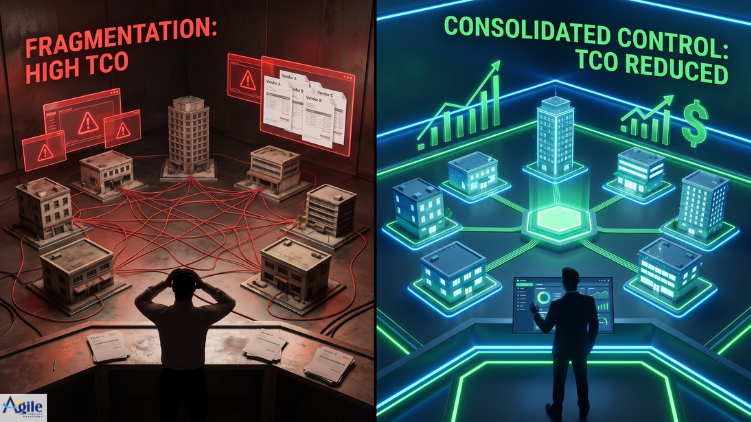
Facility Management Vendor Consolidation: A Strategic Framework to Cut TCO Late Q3 brings a familiar operational reality for facility directors and corporate real estate leaders: budget reconciliation. Managing dozens of disparate service providers across regional commercial sites creates administrative drag, inconsistent service delivery, and hidden expense leaks. Facility management vendor consolidation is the strategic practice of streamlining external service providers into a unified, managed partnership to lower total cost of ownership (TCO) and enforce consistent service level agreements across a property portfolio. Evaluating operational models and vendor structures ahead of upcoming budget cycles provides the highest return on executive effort. The following strategic framework demonstrates how consolidating facility vendors reduces TCO while raising operating standards across your entire commercial footprint. The Hidden Costs of Multi-Vendor Bloat Focusing exclusively on individual service line pricing masks the true cost of commercial facility management. Total Cost of Ownership includes all direct and indirect expenses tied to keeping commercial properties operational, safe, and compliant. When multi-site portfolios rely on a fragmented network of local suppliers for janitorial, HVAC, electrical, and grounds maintenance services, soft costs escalate rapidly. Administrative Overhead Processing individual purchase orders, invoices, and payment terms for 30 vendors across 15 sites multiplies accounts payable touchpoints. Processing a single commercial invoice averages $12 to $15 in internal overhead. Across a multi-site network, this routine administration quietly consumes thousands of budget dollars annually. Compliance and Regulatory Risk Maintaining OSHA workplace safety compliance, EPA environmental standards, and regional licensing requirements becomes increasingly complex with multiple independent vendors. A single lapse in vendor insurance verification or safety training exposes property owners to severe legal liability and financial penalties. Service Drift and Inconsistent SLAs Without centralized oversight, service execution varies widely between locations. Site A may receive exemplary preventative maintenance, while Site B suffers from deferred maintenance that shortens equipment lifespans and spikes emergency repair expenditures. 4-Step Framework for Strategic Vendor Consolidation Step 1: Conduct a Comprehensive Portfolio Spend Audit Begin by gathering every active service contract, work order history, and utility record across your commercial properties. Categorize spend into core operational buckets: Building envelope and structural maintenance HVAC, mechanical, and electrical systems Janitorial and interior environmental control Groundskeeping, asphalt, and winter services Safety, life safety, and regulatory compliance Analyze these records to identify spend fragmentation, overlapping contract scopes, and out-of-scope emergency spending patterns. Step 2: Transition from Contract Management to Strategic Account Management Managing vendors requires monitoring individual tasks. Strategic account management FM focuses on driving holistic operational outcomes across your entire portfolio. Partnering with an integrated facility services provider shifts the administrative burden. Instead of managing dozens of local points of contact, facility leadership interacts with a single strategic partner responsible for unified reporting, consolidated invoicing, and centralized service level agreement enforcement. Step 3: Establish Uniform SLAs and Compliance Protocols Standardize performance metrics across every property within your footprint. A consolidated model ensures that safety guidelines, response times, and preventive maintenance schedules remain identical regardless of location. Key performance indicators must address: First-time fix rates for mechanical systems Scheduled vs. reactive maintenance ratios Audit pass rates for safety standards Response time compliance for critical repairs Step 4: Implement Portfolio-Wide Preventive Maintenance Unplanned equipment failures generate costs up to three times higher than planned maintenance routines. Consolidating facility management services under a unified strategic partner enables systematic, preventive maintenance programs across all sites. This extension of asset lifespans yields immediate improvements to capital expenditure budgets. Vendor Bloat vs. Strategic Vendor Consolidation Operational Metric Fragmented Multi-Vendor Model Consolidated Strategic FM Model Administrative Touchpoints High: Dozens of invoices, contacts, and terms Low: Single consolidated invoice and dedicated account lead Service Level Consistency Variable across regions and site teams Uniform across every portfolio location Compliance Management Decentralized, raising regulatory risk Centralized tracking for compliance and safety standards Invoicing Complexity Multiple formats, rates, and billing cycles Standardized billing and transparent cost tracking Cost Predictability Volatile due to frequent emergency repairs Predictable through planned preventive maintenance Operational Transition Checklist Use this checklist during procurement evaluation to ensure a seamless transition: [ ] Audit Active Contracts: Document end dates, cancellation terms, and renewal windows. [ ] Map Scope Overlaps: Identify redundant services across sites. [ ] Standardize Service Expectations: Draft portfolio-wide performance requirements. [ ] Verify Partner Credentials: Confirm multi-site coverage capabilities and compliance tracking systems. [ ] Establish KPI Dashboards: Agree on key metrics before contract execution. [ ] Plan Phase-In Timeline: Schedule a phased rollout to maintain operational continuity. Transitioning Ahead of Upcoming Budget Cycles Restructuring facility management models takes preparation, making late Q3 the ideal window for procurement and facility leaders to act. Transitioning to a consolidated model before budget lock-in allows organizations to project accurate operating expenses, streamline administrative costs, and protect asset performance for the coming year. Agile Facility Solutions partners with multi-site facility directors and commercial property managers to deliver integrated facility management models tailored to complex commercial portfolios. Contact our operational team today to schedule a portfolio spend and SLA review. Frequently Asked Questions How does vendor consolidation reduce total cost of ownership (TCO) in facility management? Vendor consolidation reduces TCO by eliminating redundant administrative processing costs, reducing emergency repair costs through standardized preventive maintenance, leveraging volume scale across portfolio properties, and minimizing compliance penalty risks through centralized management. Will consolidating vendors impair local responsiveness for individual properties? No. A structured strategic account management model pairs centralized oversight with vetted local or regional technical execution. Facility managers gain the accountability of a dedicated account lead while maintaining rapid on-site service delivery. When is the best time of year to execute a facility management vendor consolidation strategy? Late Q3 is optimal for evaluating vendor consolidation. This timing allows facility leaders to audit current spend, finalize standardized SLAs, and incorporate streamlined operational costs into upcoming fiscal budget cycles without interrupting mid-year operations. What commercial facility services are typically included in vendor consolidation? Core integrated services usually include HVAC and mechanical maintenance, janitorial and interior sanitation, electrical and lighting systems, groundskeeping, parking lot maintenance, and general commercial

Facility Management Vendor Consolidation: A Strategic Framework to Cut TCO Read More »

The Future of Integrated Facility Management: The 2026 Guide for Operations Leaders

In the high-stakes world of commercial real estate and corporate operations, “business as usual” is aliability. For years, facility management was viewed as a reactive cost center – a series of disconnected line items for janitorial services, HVAC repair, and landscaping. But the landscape has shifted.

The Future of Integrated Facility Management: The 2026 Guide for Operations Leaders Read More »

Scroll to Top